
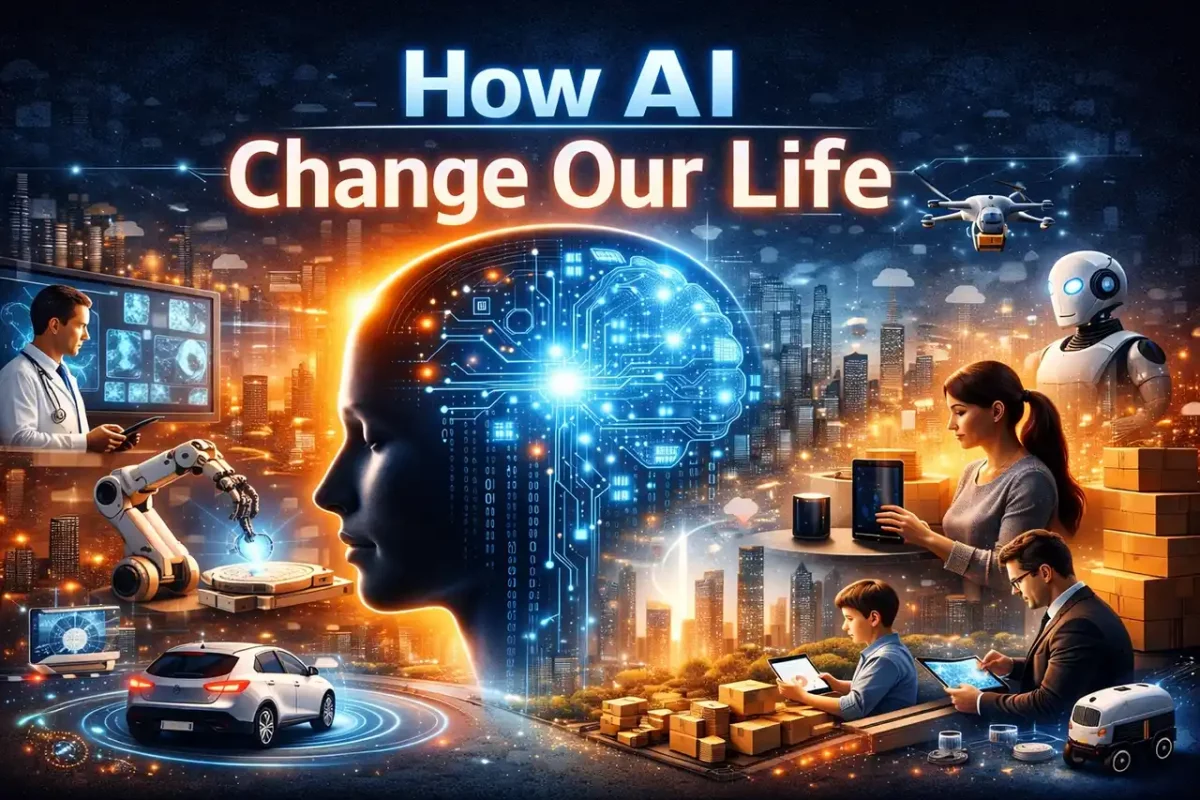
Imagine waking up one morning and realizing that many of your daily decisions—what route you take to work, what content you consume, even how you manage your health—are subtly guided by invisible systems working behind the scenes. This is not a distant future or a sci-fi scenario; it is already happening. Artificial Intelligence (AI) has quietly embedded itself into our lives, reshaping how we live, work, and think in ways we often overlook.
In this in-depth article, we explore how AI change our life, examining its real-world impact, opportunities, challenges, and what it means for our future as individuals and as a society.
Understanding Artificial Intelligence in Simple Terms
Artificial Intelligence refers to computer systems designed to perform tasks that typically require human intelligence. These tasks include learning from data, recognizing patterns, understanding language, making decisions, and even predicting future outcomes.
From Rule-Based Systems to Learning Machines
Early software systems worked based on fixed rules written by programmers. Modern AI, however, relies heavily on:
Machine Learning (ML)
Deep Learning
Natural Language Processing (NLP)
Computer Vision
These technologies allow AI systems to improve over time without explicit reprogramming, which is why their influence is growing so rapidly.
Why AI Adoption Is Accelerating
Several factors have contributed to the explosive growth of AI:
Massive amounts of data generated daily
Increased computing power
Cloud infrastructure accessibility
Advancements in algorithms
Together, these elements have made AI more powerful, affordable, and scalable than ever before.
How AI Change Our Life in Everyday Activities
AI is no longer limited to research labs or large corporations. It is deeply integrated into our daily routines.
Smart Assistants and Personalized Experiences
Virtual assistants like Siri, Google Assistant, and Alexa are prime examples of AI in everyday life. They help users:
Set reminders
Control smart home devices
Search for information using voice commands
At the same time, recommendation systems on platforms like Netflix, YouTube, and Spotify personalize content based on user behavior, saving time and enhancing user satisfaction.
AI in Communication and Social Interaction
AI-driven algorithms shape what we see on social media, influence online conversations, and even help detect spam or harmful content. Translation tools powered by AI have also broken language barriers, enabling real-time communication across cultures.
The Impact of AI on Work and Employment
One of the most discussed aspects of how AI change our life is its effect on jobs and the workplace.
Automation and Job Transformation
AI is automating repetitive and time-consuming tasks such as data entry, scheduling, and basic customer support. While this raises concerns about job displacement, it also creates opportunities for:
New roles in AI development and management
More focus on creative and strategic tasks
Increased productivity and efficiency
AI as a Collaborative Tool, Not Just a Replacement
Rather than replacing humans entirely, AI often acts as an assistant. For example:
Designers use AI tools to generate ideas faster
Doctors use AI to support diagnosis
Marketers use predictive analytics to optimize campaigns
The future of work is increasingly about human–AI collaboration.
AI in Healthcare: Saving Time, Money, and Lives
Healthcare is one of the most impactful areas where AI is transforming lives.
Early Diagnosis and Personalized Treatment
AI algorithms can analyze medical images, lab results, and patient histories with remarkable accuracy. This enables:
Early detection of diseases like cancer
Personalized treatment plans
Reduced diagnostic errors
Improving Accessibility and Efficiency
AI-powered chatbots and virtual health assistants provide basic medical guidance, especially in areas with limited access to healthcare professionals. Hospitals also use AI to optimize scheduling, manage resources, and reduce waiting times.
Education in the Age of Artificial Intelligence
Education systems around the world are being reshaped by AI technologies.
Personalized Learning Experiences
AI-driven educational platforms adapt to each learner’s pace, strengths, and weaknesses. This personalization helps:
Improve learning outcomes
Reduce frustration and dropout rates
Support lifelong learning
Redefining the Role of Teachers
Rather than replacing educators, AI allows teachers to focus more on mentoring, creativity, and critical thinking by automating grading and administrative tasks.
How AI Change Our Life Through Business and Economy
AI has become a key driver of innovation and competitive advantage in business.
Smarter Decision-Making with Data
Businesses use AI to analyze massive datasets and gain insights that were previously impossible. Applications include:
Demand forecasting
Customer behavior analysis
Risk management
Enhancing Customer Experience
From chatbots to personalized product recommendations, AI helps companies deliver faster, more relevant, and more satisfying customer interactions.
Ethical Challenges and Risks of AI
Despite its benefits, AI also raises serious ethical and social concerns.
Privacy and Data Security
AI systems rely on vast amounts of data, often personal and sensitive. This creates risks related to:
Data misuse
Surveillance
Unauthorized access
Bias and Fairness
AI models can unintentionally reinforce existing biases if trained on flawed data. This can affect decisions in hiring, lending, law enforcement, and more.
The Need for Responsible AI
To ensure AI benefits everyone, governments and organizations must focus on:
Transparency
Accountability
Ethical guidelines
Human oversight
The Future: How AI Will Continue to Change Our Life
Looking ahead, AI is expected to become even more integrated into society.
Emerging Trends in Artificial Intelligence
Some key developments to watch include:
AI-powered creativity in art and content creation
Autonomous vehicles and smart cities
Advanced human–machine interfaces
Preparing for an AI-Driven World
To thrive in the future, individuals should focus on:
Digital literacy
Adaptability and continuous learning
Developing uniquely human skills such as empathy and critical thinking
Conclusion: Embracing Change with Awareness and Purpose
There is no doubt that how AI change our life is one of the most defining questions of our time. From simplifying daily tasks to transforming industries like healthcare, education, and business, AI offers immense potential to improve quality of life. At the same time, it challenges us to think carefully about ethics, responsibility, and the role of humans in an increasingly automated world.
The key is not to fear AI, but to understand it, use it wisely, and shape its development with human values at the core. By staying informed and proactive, we can ensure that AI becomes a powerful ally—one that enhances our abilities, expands our opportunities, and helps build a smarter, more balanced future.
